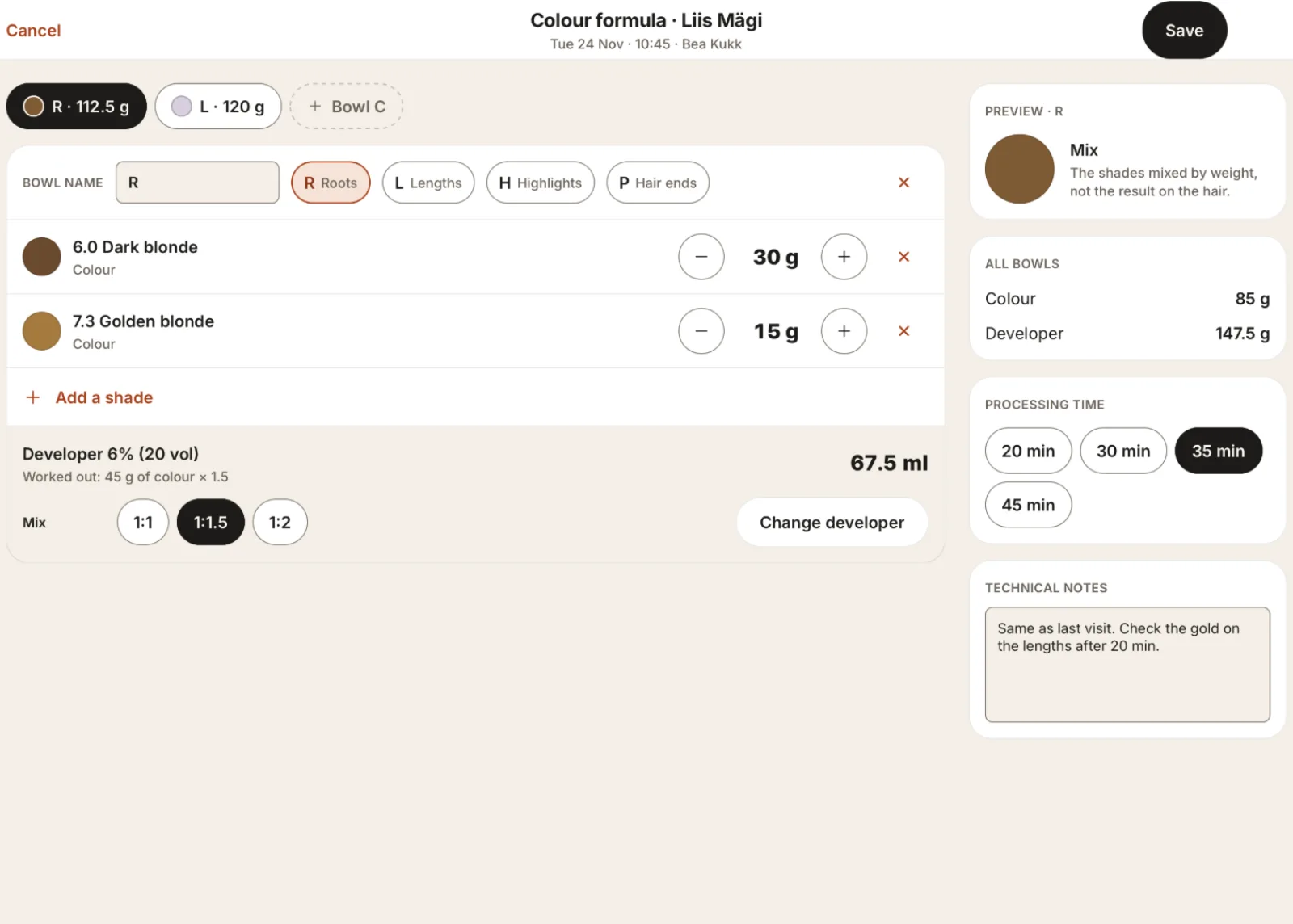
What a mixing ratio means
A ratio says how much developer goes with each part of colour. The first number is the colour, the second is the developer:
- 1:1 means one part colour to one part developer: the same weight of each.
- 1:1.5 means one and a half parts developer for each part of colour.
- 1:2 means twice as much developer as colour.
Weigh the colour first, then multiply. The arithmetic is the same whatever the line:
| Colour in the bowl | 1:1 | 1:1.5 | 1:2 |
|---|---|---|---|
| 20 g | 20 g developer | 30 g developer | 40 g developer |
| 40 g | 40 g developer | 60 g developer | 80 g developer |
| 60 g | 60 g developer | 90 g developer | 120 g developer |
When a bowl holds several shades, the ratio applies to the total colour. 30 g of one shade and 10 g of another make 40 g of colour, so a 1:1.5 mix takes 60 g of developer. Weighing in grams makes this exact, which is one of the reasons to weigh hair colour in grams in the first place.
Ratio and developer strength are not the same thing
Two separate choices go into the developer, and they are easy to confuse:
- Strength is the concentration of hydrogen peroxide, given as a percentage or in volumes: 3% (10 volume), 6% (20 volume), 9% (30 volume) and 12% (40 volume). The strength is what you choose for the result: how much lift you need, or a gentler developer for deposit and toning.
- The ratio is the proportion of developer to colour. It is part of how the product was formulated, and the manufacturer sets it for each line, and sometimes for each series within a line.
In other words, you choose the strength for the job, within what the manufacturer allows, and you follow the ratio. Changing the ratio is not a way to get more or less lift.
Why lifting and depositing products are mixed differently
Colour does two jobs at once: the developer lightens the natural pigment, and the dye deposits the new tone. How much of each a product does decides how it is formulated.
- Lifting products, such as high-lift series, are designed to lighten further and deposit less. They often call for a larger share of developer and a stronger one, as set by the manufacturer.
- Standard permanent shades balance lift and deposit, and grey coverage depends on the colour being mixed and processed exactly as intended.
- Deposit-only and toning products, such as demi-permanents and glosses, add tone with little or no lift and usually use a low-strength developer made for them.
That is why ratios differ from one product to the next, even within the same brand. There is no single right ratio for “a lift” or “a toner”: the right one is the one printed for the product you are using.
Follow the manufacturer, every time
Each line is tested with its own developer at its own ratio. Check the mixing instructions in the line’s technical guide or on the packaging, and keep to them:
- Use the developer made for the line, or one the manufacturer approves for it.
- Check special series separately. High-lift, pastel and grey-coverage series can have their own ratio and strength.
- Check additives. Bond builders, boosters and mixing concentrates each have their own instructions, including whether they count towards the colour side of the ratio.
- Keep the line’s guide at the mixing station, so nobody works from memory.
Mixing outside the ratio changes the product. Too little developer gives a thicker mix that may not process as intended. Too much dilutes the dye, which can weaken coverage and tone. Either way, the result no longer matches the formula you wrote down.
How to record the ratio on a formula
Write the developer as precisely as the colour. For each bowl, note:
- Each shade and its grams, and the total colour.
- The ratio you mixed at.
- The developer strength, as a percentage or in volumes.
- The developer in grams, worked out from the total colour and the ratio.
- The processing time, and anything that changed during the service.
Example only, with invented shades: Roots: 7.1 30 g + 7.3 10 g = 40 g colour. Ratio 1:1.5. Developer 6% (20 vol), 60 g. Processing 35 minutes. Follow the ratio your manufacturer gives for the line you use.
When roots and lengths need different mixes, give each its own bowl, ratio and developer. A formula that records the ratio can be mixed again by anyone, and it shows straight away if someone used a different one last time.
Ratios in Artover Appointment
Disclosure: Artover Appointment is our own salon software. Its colour formulas are built around the points above:
- Pick the ratio for each bowl, 1:1, 1:1.5 or 1:2, and the developer is worked out from the grams of colour in that bowl.
- Planned and actual grams are entered in the app, in 5 g steps.
- Each formula sits on the appointment, so the next visit starts from the client’s last formula, ratio included.
- Tubes are tracked to the gram in your stock.
You still choose the ratio your manufacturer gives: the app does the arithmetic, not the chemistry. See the colour formulas page.
Frequently asked questions
What does a 1:2 developer ratio mean?
One part colour to two parts developer, by weight. For 40 g of colour, you add 80 g of developer. Use 1:2 only when the manufacturer gives it for the product you are mixing.
Is 1:1.5 the same as 1 to 1 and a half?
Yes. For each gram of colour you add one and a half grams of developer, so 40 g of colour takes 60 g of developer.
Can I change the ratio to get more lift?
No. Lift comes from the developer strength and the product you choose, within the manufacturer’s instructions. The ratio is part of how the product is formulated, and changing it alters the result in ways the formula no longer describes.
Does the ratio apply to each shade or to the whole bowl?
To the total colour in the bowl. Add up the grams of every shade, then work out the developer from that total. Check the manufacturer’s instructions for additives.