The problem with “a squeeze of tube”
Mixing by eye feels quick, but it hides a lot of guesswork:
- Tubes are not all the same size. Lines come in different tube sizes, so “half a tube” means a different amount depending on the brand in your hand.
- Opened tubes lie. A tube that has already been used once gives no clue how much is left, and “a third of what’s left” is not a quantity anyone can repeat.
- Every hand squeezes differently. Two stylists mixing the same written formula by eye will not mix the same bowl.
- The developer is guessed too. If the colour is a guess, the developer measured against it is a guess as well, and the mixing ratio the manufacturer designed the colour for is lost.
None of this matters much for a one-off. It matters a great deal for a regular client whose roots have to match the lengths every six weeks.
Consistency between visits
A formula written in grams is a recipe, not a description. “7.1 30 g, 7.3 10 g, developer at the line’s ratio” can be mixed again in six weeks and give the same bowl. A note that says “mostly 7.1, bit of gold” cannot.
Grams also make adjustments precise. If the result came out a touch too warm, the next formula can move 5 g from the gold shade to the ash one, and you know exactly what changed. When the result is right, you know exactly what to repeat. Over a few visits the formula improves instead of drifting.
Wherever you keep it, a paper record card or a colour formula app, the formula is only as good as the quantities written on it.
Consistency between stylists
A formula in grams belongs to the salon, not to the stylist who mixed it. That matters when:
- A stylist is off or on holiday and a colleague takes the client.
- An assistant mixes the bowl while the stylist finishes another client.
- Someone leaves the salon. Their clients’ formulas stay, written in a form anyone on the team can follow.
- You train a junior. Weighing teaches what a root retouch or a full head really needs, faster than watching someone squeeze.
Less colour in the bin
Mixing by eye tends to err on the generous side, because running out mid-application is worse than throwing some away. The leftover in the bowl goes in the bin, and so does the developer mixed with it.
Weighing turns that into something you can manage. When you note how much was left over, the next formula for that client can be smaller. After a few visits you know what her roots need, and you stop mixing for a head of hair she does not have. Tubes also last longer and run out when you expect them to, which makes reordering easier.
We will not put a figure on the saving: it depends on your prices, your clients and how generous your team’s hands are today. The way to find out is to weigh for a month and look at the leftovers you record.
How to weigh a bowl, step by step
- Put the empty bowl on the scale and set it to zero (tare).
- Add each shade and note its grams before adding the next, setting the scale back to zero each time if that is easier.
- Work out the developer from the grams of colour and the mixing ratio the manufacturer gives for that line, then weigh it in. Our guide to developer ratios explains how.
- Keep one bowl per zone when roots, lengths or highlights need different formulas, each with its own grams.
- After the service, note what was really used, including anything you had to mix again and what was left in the bowl.
A simple kitchen-style digital scale that reads in grams is enough to start. Keep one at each mixing station so nobody is tempted to skip it.
Record planned and actual grams
Two columns do most of the work. Planned is what you intended to mix before the service. Actual is what really went on the hair: the planned amount, plus anything mixed again, minus what was left in the bowl.
| Bowl | Shade | Planned | Actual |
|---|---|---|---|
| Roots | 7.1 | 30 g | 30 g |
| Roots | 7.3 | 10 g | 10 g |
| Roots | Developer, 1:1.5 in this example | 60 g | 60 g |
| Lengths | 8.1 | 40 g | 30 g (10 g left over) |
Example only: the shades, grams and ratio above are invented to show the layout. Follow each manufacturer’s mixing ratio for the line you use.
Keeping both tells you different things. The planned column is the recipe for next time. The actual column shows where you over-mix and what really came off your stock. When the two keep differing for a client, adjust the plan.
Add what grams alone do not capture: the developer strength, the processing time, the date, who did the colour, and a short note such as “check the lengths after 20 minutes”.
Making it a team habit
- Write the formula before you mix, not from memory afterwards.
- Use grams for everything, colour and developer alike, so nobody converts in their head.
- Agree one place for formulas, whether that is a card box or an app, and make it the only one.
- Check the last formula before the client sits down, so the consultation starts from facts.
Keeping formulas in Artover Appointment
Disclosure: Artover Appointment is our own salon software. If you would rather not keep formula cards by hand, this is what it does for colour:
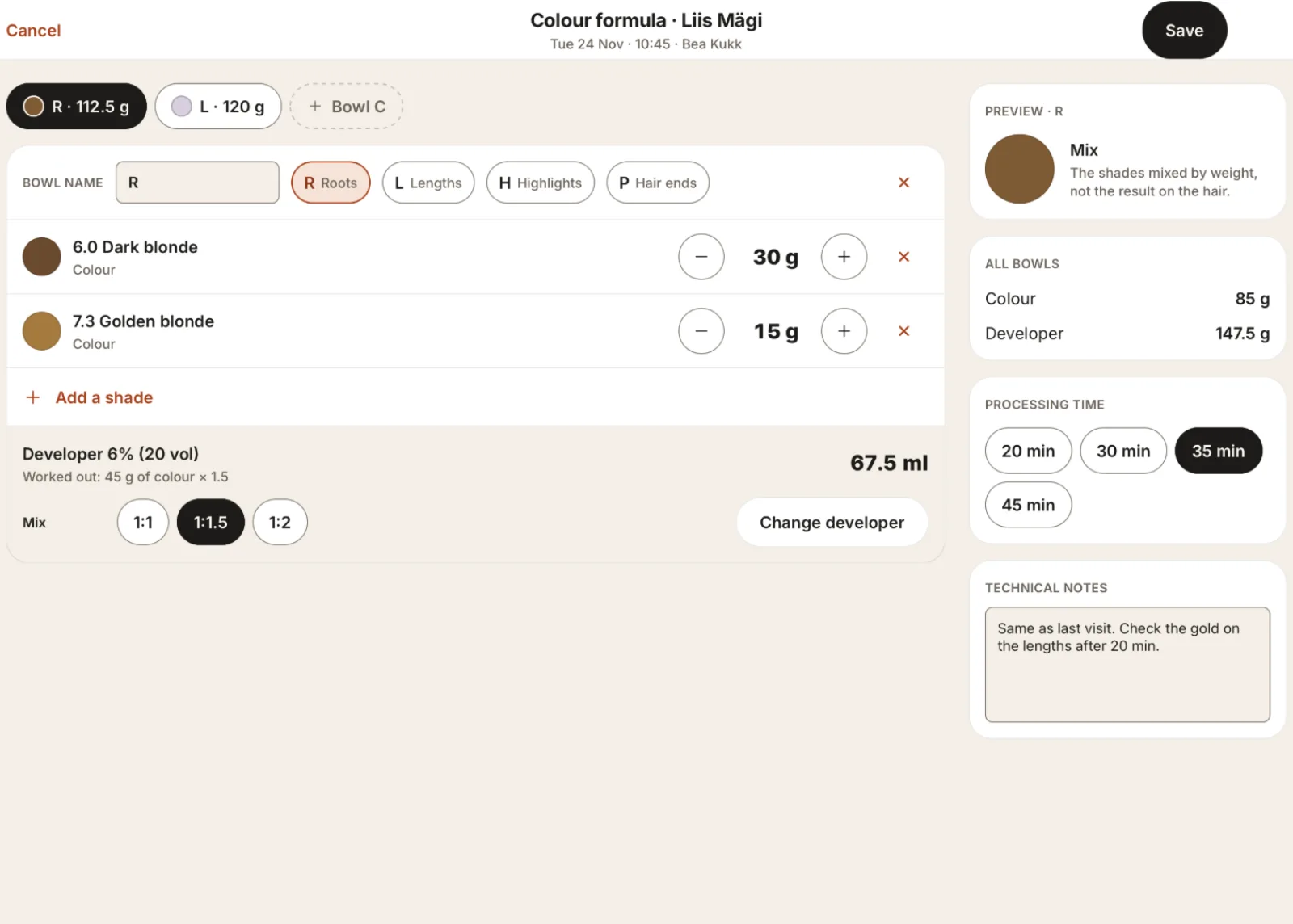
- A formula on each appointment, with one bowl per zone and each shade in grams.
- Planned and actual grams entered in the app, in 5 g steps. There is no scale connection: you weigh on your own scale and enter the grams.
- The developer worked out from the ratio you choose: 1:1, 1:1.5 or 1:2.
- The client’s last formula to start from at the next visit.
- Tubes tracked to the gram in your stock, so what was used comes off the shelf.
See how it works on the colour formulas page.
Frequently asked questions
Why do colourists weigh hair colour?
Because a formula in grams can be mixed again exactly, by anyone on the team. It gives the same result at the next visit, makes small adjustments measurable, keeps the developer at the manufacturer’s ratio and cuts the colour thrown away.
Do I need a special scale to weigh hair colour?
No. Any digital scale that reads in grams and can be set to zero with the bowl on it will do. Keep one at each mixing station so weighing becomes the habit.
What is the difference between planned and actual grams?
Planned is what you intended to mix before the service. Actual is what really went on the hair: the planned amount, plus anything mixed again, minus what was left in the bowl. Planned is the recipe, actual shows real use.
Should I weigh the developer too?
Yes. Weigh the colour first, work out the developer from the manufacturer’s mixing ratio for that line, then weigh the developer in. A guessed developer changes the mix as much as a guessed colour.